IV. Bahri
Mamluk Period (1251-1381 AD)
#1 Mosque
of al-Zahir Baybars al-Bunduqdari [Baybars I] (1269 AD) H-1
Restoration: in the 1990's by the
Egyptian Antiquities Organization/Supreme Council of Antiquities. It was
apparently in too ruinous a condition to warrant prior restoration.
The only original decorative stone remaining
are a few columns, mostly fallen and broken.
Just inside the northeast entrance,
immediately on the left/east: several column fragments, one of Aswan granite
and the others of Proconnesian marble.
Qibli liwan: on the ground to the
left/north of the prayer niche there are a whole column and a column fragment
of Aswan granite, and a whole column of granito violetto. There are 3 upright
columns at the corners of two pillars in front of the mihrab — one is probably
bigio antico with a Corinthian capital, and the other two are light gray marble
with Byzantine ? capitals. To the right/south of the mihrab are 14 new ? light
gray marble columns standing with identical fancy Islamic capitals.
Visited by: JAH in '96.
References: C59, 155-173; B-A89,
94-95; MW92, 39-40; S-WS88,
408; W02, 223-225.
#279 Mausoleum of
Mustafa Pasha (1269-73 AD) G-10
According
to Creswell (1959: 178-180) there is no decorative stone inside, but it has an
entrance sill of Aswan granite (uninscribed?).
Not
visited.
Other
references: S-WS88, 383.
#274 Mausoleum of
Fatima Khatun [a.k.a. Umm al-Salih] (1283-4 AD) F-9/F-10
According
to Creswell (1959: 180-185) there is no decorative stone inside, but the many
empty niches indicates that it originally had at least 12 marble columns.
Not
visited.
Other
references: S-WS88, 338; W02, 111-112.
#146 Khanqah/Mausoleum
of al-Bunduqdariya (1284-5 AD) F-7/F-8
According
to Creswell (1959: 185-180) there is no decorative stone inside but empty recesses
indicate that the mihrabs in each of the two mausoleums were originally flanked
by marble columns.
Not
visited.
Other
references: S-WS88, 334; W02, 104.
#43 Mosque/Madrasa/Mausoleum/Maristan
of Sultan al-Mansur Qalawan (1284-5 AD) H-4
Restoration:
in 1903-1912 by the Comité.
The maristan (hospital) is now in ruins
and largely gone. No decorative stone survives except possibly for a fountain
with a colorful stone mosaic (not seen).
ENTRANCE
Sill: uninscribed Aswan granite.
Flanking columns: 2 on each side in
matching/opposing pairs - Aswan granite (inner pair) and Aswan granodiorite
(outer pair) with a variety of Corinthian capitals.
Facade: basalt (or black limestone?)
and "white" marble ablaq with light gray marble colonettes.
EAST SIDE FACADE
Numerous light gray marble columns
(mostly if not entirely Proconnesian) with a variety of Corinthian capitals.
MAUSOLEUM
COURTYARD
A massive sill of either Aswan
granite or granodiorite is crossed at the entrance to the courtyard (coming
from the corridor). Inside there are 6 massive columns of Aswan granite (4) and
Aswan granodiorite (2, flanking the mausoleum entrance) with a variety of
Corinthian capitals. In places these are covered with red paint.
MAUSOLEUM
INTERIOR
Columns: (1) flanking the west
entrance — 2 Proconnesian marble columns with spirals (upper half) and fluting
(lower half), and Corinthian capitals; (2) in wall niches — 34 Proconnesian
marble columns with Islamic capitals; (3) around the 4 columns supporting the dome
— 16 Proconnesian marble columns with Corinthian capitals; (4) in the center
supporting the dome — 4 huge (7 m high) Aswan granite columns with ornate
guilded Corinthian capitals; and (5) flanking the mihrab are 3 columns on each
side in matching/opposing pairs with white marble Islamic capitals — octagonal
Proconnesian marble (front), round MP imperial porphyry (middle), and round
Aswan granodiorite (back).
Wall panels: mostly Proconnesian
marble, and light and dark gray varieties of Carrara marbles with occasional
panels of other stones: red-and-white breccia [broccatelli d'Egitto?] (at the
NW, NE, SW and SE corners), bianco e nero antico (4 large panels flanking the
west side entrance), pavonazzetto (1 panel in the window niche on the south
side of the mihrab), and bigio lumachellato. Elaborate wall mosaics are made
from "black" and "white" marbles, and pink, red and orange
limestones plus, in the upper parts of walls above the panels, mother-of-pearl
and, in the 4 corners, cipollino rosso brecciato. The paneling covers the lower
4.2 m of the walls.
Mihrab: has no stone paneling, only
an intricate polychrome stone mosaic like that found on parts of the walls.
Cenotaph: Proconnesian marble, but
around the base there are 22 small panels of WUS diorite, and "black"
and "white" marbles.
Pavement: a decorative pavement
exists only around the cenotaph, and between the cenotaph and mihrab, and
cenotaph and west-side entrance. How much of it is original is unclear. It
consists of intricate designs with small pieces of "black" and
"white" marbles, and fossiliferous red limestones set around large
slabs of Proconnesian marble. There is a single rota of MP imperial porphyry at
the west entrance.
MADRASA
Qibli liwan: at the entrance are 2 Proconnesian
marble columns with Corinthian capitals, and inside are 6 huge columns of Aswan
granite with a variety of Corinthian capitals. The columns have what appear to
be a Pharaonic symbol inscribed (in raised relief) near their tops (it
resembles three concentric U's). This same symbol can be seen on 4 columns of
Aswan granite now in gallery 42 of Cairo's Egpytian Museum but originally from
the pyramid temple at Abusir of the 5th dynasty king Sahure. The
interior is undecorated except for the prayer niche.
Mihrab: 2 flanking columns of bigio
antico with Corinthian capitals. There are 6 tiers of panels. From bottom (1)
to top (6) these consist of the following stones: (1) africano, verde antico,
cipollino rosso venato, and "black" and "white" marbles;
(2) bigio lumachellato and light gray marble; (3) light gray marble; (4) all
panels are missing; (5) verde antico and light gray marble; and (6) verde
antico, cipollino rosso brecciato, and bianco e nero antico. The light gray,
"white" and "black" marbles may all be new. The lighter
ones are Proconnesian and marmo bianco di Carrara, and the darker ones are
bardiglio di Carrara.
South liwan: only 2 light gray
(Proconnesian?) marble columns with Corithian capitals. The west liwan has been
destroyed and there is no north liwan.
Visited by: JAH in '96 & '99; MB
& LL in '99.
References: C59, 190-212; B-A89,
95-100; MW92, 41-42; S-WS88, 244; W02, 165-168.
#296 Mausoleum of
al-Sawabi (1286 AD) G-10
According
to Creswell (1959: 213-214) there is no decorative stone inside.
Not
visited.
Other
references: S-WS88, 378; W02, 116.
#275 Mausoleum of
Sultan al-Ashraf Khalil (1288 AD) F-10
According
to Creswell (1959: 214-218) this building was originally richly adorned with
decorative stones, including marble wall paneling up to 3 m high and marble
columns flanking the mihrab and doorways. Only 3 pieces of marble paneling (1
red and 2 white) remained in the mihrab.
Not
visited.
Other
references: S-WS88, 339; W02, 112.
#186 Mausoleum of Husam
al-Din Turuntay al-Mansuri (1290 AD) G-5
According
to Creswell (1959: 218-219) there is no decorative stone inside. Empty recesses
indicate that the mihrab was originally flanked by 2 marble columns.
Not
visited.
Other
references: none.
#245 Mausoleum of
Ahmad Ibn Sulayman al-Rifai (1291 AD) G-7
According
to Creswell (1959: 219-222) there is no decorative stone inside.
Not
visited.
Other
references: none.
#44 Madrasa/Mausoleum
of Sultan al-Nasir Muhammad (1296-1304 AD) H-4
Restoration: around the turn of the
century by the Comité, and in 1985-86 by the German Archaeological Institute.
ENTRANCE
There is a gothic/Christian portal
of "white" marble brought in 1291 AD from Acre (or Akka) in
Palestine, and an uninscribed Aswan granite sill.
MAUSOLEUM
The only decorative stones are 4
columns: 2 flanking the prayer niche and 2 flanking the west side entrance. All
are verde antico with Corinthian and Byzantine? capitals.
MADRASA
(now in a ruinous state)
Flanking the mihrab are 2 columns of
Wadi Hammamat conglomerate (both 3.5 m high with a 1.3 m circumference near the
base). In the courtyard are 2 columns on the ground: both are brown siliceous
sandstone. These may not come from this building as it is now being used for
storage by the Supreme Council of Antiquities. There are no other decorative
stones.
Visited by: JAH in '96 & '99; MB
& LL in '99.
References: C59, 234-240; B-A89,
100-101 & 112-113; MW92, 43; S-WS88, 243; W02, 169-170.
#172 Mosque/Zawiya/Mausoleum
of Zayn al-Din Yusuf (1298 AD) G-10
Renovation:
around the turn of the century by the Comité.
MOSQUE
The only decorative stones are 2
columns of Proconnesian marble with Islamic capitals.
MAUSOLEUM
Creswell (1959: 232-233) reports seeing
extensive marble paneling from the early 1300's, but these appear to be gone
now. Today there are new wall panels and mosaics using light and dark
gray marbles, and red and rare green limestones.
Visited by: JAH in '96.
References: C59, 229-233; B-A89,
111-112; S-WS88, 384; W02, 121-122.
#292 Mausoleum of Ali
Badr al-Din al-Qarafi (1300 AD) G-10
According
to Creswell (1959: 265-266) there is no decorative stone inside but originally
it had marble wall paneling.
Not
visited.
Other
references: S-WS88, 378; W02, 116.
#31 Madrasa/Mausoleum
of Amir Qarasunqur (1300 AD) H-4
Restoration:
the mausoleum only in the 1890's by the Comité.
The madrasa was long ago converted to a
boys school and nothing remains of the original decorative stone. Only the
mausoleum has some (all in the mihrab) and it is badly deteriorated. The mihrab
is flanked by 2 round columns of bigio antico with Islamic capitals and bases.
Inside there is a single, lower tier of panels with alternating red and black
limestones with "white" and "black" marble trim. Above is a
geometric design using "white" and "black" marbles, red
limestone, and mother-of-pearl.
Visited by: JAH & MB in '99.
References: C59, 240-242; S-WS88, 222;
W02, 189.
#221 Madrasa/Khanqah/Mausoleum
of Solar and Sangar al-Gawli (1303-4 AD) E-8
Restoration: in 1894 by the Comité, and
in the late 1990's by the Supreme Council of Antiquities.
ENTRANCE
There
is a sill of uninscribed brown siliceous pebbly sandstone.
MADRASA/KHANQH
There is no decorative stone inside.
MAUSOLEUM
The only decorative stone is in the Solar
mausoleum where it occurs in a narrow band along the top of the east wall, and
in and just above the mihrab. The same stones are used throughout: light and
dark gray marbles, red and orange limestones with rare pieces of cipollino
rosso brecciato and rosso di Francia. The latter stone is certainly new. There
are no columns flanking the mihrab. The burial has no marble cenotaph, just a
low wall of light and dark gray marbles. Sangar al-Gawli's mausoleum is bare
except for the cenotaph of light gray marble.
Visited by: JAH in '97 & '99; MB in
'99.
References: C59, 242-245; B-A89, 101-104;
MW92, 44-47; S-WS88, 348; W02, 42-44.
#32 Khanqah/Mausoleum
of Sultan Baybars al-Gashankir (1306-10 AD) H-3
Restoration: in the 1890's by the Comité
and again, to a minor extent, in the late 1990's by the Supreme Council of
Antiquities.
ENTRANCE
Has a brown siliceous sandstone sill with
hieroglyphics. There are also a lot of "black" and "white"
marbles (much of it Proconnesian) on the walls adjacent to the portal.
MAUSOLEUM
Pavement: "black" and
"white" marbles (some Proconnesian). These same two stones predominate
in the wall panels as well. The relatively few occurrences of other stones are
given below.
The
stone paneling covers the lower 3.6 m of the walls.
West wall: panels of WH conglomerate
flank the entrance as do also two octagonal columns of light gray marble with
Islamic capitals.
South wall panels: occhio di pavone
rosso, brownish pink astracane dorato (d'Egitto?), bigio lumachellato, and
bigio antico. Inside the opposing walls of the window niche are 2 long strips
of WH conglomerate.
North wall panels: bigio
lumachellato, occhio di pavone rosso (possibly the subvariety lumachellato di
Sibila), an unknown contorted light brown (discolored?)/dark gray fossiliferous
limestone, plus some assorted new (replacement) marbles.
East wall panels: MP imperial
porphyry (2 large panels on each side flanking the mihrab). There are also
extensive, intricate mosaics made with small pieces of "black" and
"white" marbles, fossiliferous red limestone, cipollino rosso
brecciato, and astracane dorato (d'Egitto?). This stone mosaic is very similar
to the one inside the mihrab.
Mihrab: there are 7 panels in the
lower tier but identification is difficult because of the dirt coating. Three
of the panels are breccias — pavonazzetto (1), and verde antico (2). The other
panels appear to be astracane dorato (d'Egitto?, 3), and black marble (1). The
upper tier of panels include: verde antico, astracane dorato (d'Egitto?), and
red and black limestones. The 2 flanking columns are identical to those
flanking the mausoleum entrance on the west wall.
Trim: all walls have
"black" and "white" marble trim.
PASSAGEWAY BETWEEN MAUSOLEUM AND
KHANQAH
Mostly Proconnesian and
"black" marbles with a few pieces of polychrome marble.
KHANQAH
The only decorative stones are the
two octagonal columns of Proconnesian marble flanking the mihrab. Both have
Islamic capitals.
Visited by: JAH in '96, '97 &
'99; MB in '99.
References: C59, 249-253; B-A89,
104-107; MW92, 48-49; S-WS88, 223; W02, 187-189.
#521 Mosque of Ahmad Bey Kohya (1310 AD) F-8
This building
is an empty and partially collapsed shell. An old man long in the neighborhood
said that when the mosque was in use it had no decorative stone inside.
Visited by: JAH in '00.
References: S-WS88, 335.
#549 Palace of al-Nasir Muhammad [a.k.a.
Qasr Al-Ablaq ] (1314 AD) G-8/H-8
Portions of
only two rooms can now be seen, and only from above at about a 15 m distance.
These rooms are now unroofed and in ruins. It is evident that the interior
walls were once covered with decorative stone to a considerable height judging
from the panel impressions seen in the remaining plaster. Several of the
original decorative panels remain on the step/rise between the two rooms. With
the aid of binoculars, these panels appear to be verde antico (3 attached plus
1 loose on the ground), WUS diorite (1), red-and-white breccia (2 attached plus
1 loose on the ground), and "white" and "black" marbles.
Slabs of Proconnesian marble are used for the pavement above the step/riser.
Lying on the ground above the ruins, on their south side and at modern-day
ground level, are 4 large columns of Aswan granite.
Visited by: JAH in '00.
References: S-WS88, 374; W02, 202.
#270 Mausoleum of
Safi al-Din Gawhar (1315 AD) F-8
According
to Creswell (1959: 266-267) there is no decorative stone inside.
Not
visited.
Other
references: none.
#263 Madrasa/Mausoleum
of Amir Sunqur Sadi [a.k.a. Tomb of Shaykh Hasan Sadaqa] (1315-21 AD) F-8
This building
is kept closed and locked due to structural problems. Apart from the mausoleum,
only the northwest liwan of the madrasa survives. According to Creswell (1959:
267-269) there is no decorative stone inside and looking through a window into
the mausoleum this does indeed appear to be the case. Notably, the 3 marble
colonnettes flanking the window above the outside entrance are war spoils from
Palestine.
Visited by: JAH & MB in '99.
Other references: B-A89, 107-108; S-WS88,
331; MW02, 103-104.
#176 Mosque of Qadi
Sharaf al-Din (1317-37 AD) G-4
There
is no decorative stone inside.
Visited
by: JAH in '00.
References:
S-WS88, 283.
#143
Mosque of Sultan al-Nasir Muhammad (1318-35 AD) H-8
Wall panels: the walls are largely
devoid of stone panels except in the mihrab and the adjacent wall surfaces. The
mihrab contains all new stones (dating from the early 1900's and including
light and dark gray marbles, verde alpi, fossiliferous red limestone, broccato
di Verona, black and orange limestones, and mother-of-pearl) except for
several, somewhat deteriorated panels of verde antico that are probably
original. On the north wall are fragments of the original red-and-white breccia
paneling, and on the south wall there is a red-and-white breccia rota (all cipollino
rosso brecciato?). Around these are smaller trim panels of white, black and red
stone. A medieval chronicler describes the walls of this mosque as being
completely covered with marble paneling. The remaining traces indicate that
only the lower 5 meters were covered.
Pavement: Mokattam limestone.
Columns: there are a total of 74
columns – 24 around the edge of the central open courtyard, 28 inside the qibli
liwan, 6 in both the north and south liwans, and 10 in the west liwan. Included
among these columns are 24 of Aswan granite (10 of these are especially large),
2 of Aswan granodiorite, 28 of Proconnesian marble, 9 of bigio antico, 2 of
bigio lumachellato, 1 of cipollino verde, 1 of granito violetto (in the NW
corner of the courtyard), and 7 of an unknown light gray marble with black
styolitic veins. These have mostly Corinthian and Byzantine capitals with some
Islamic types as well.
Visited by: JAH in '96 & '00.
References: B-A89, 108-110; MW92,
52; S-WS88, 370; W02, 201-202.
#233 Mosque/Mausoleum
of Amir Husayn (1319 AD) F-5
There is a single liwan, all but the
qibli have been destroyed. The only decorative stones are 4 columns of
Proconnesian marble, and in and around the mihrab. All of the latter appears to
be new: panels of "white" and dark gray marble, and breccia rossa
Appeninica; and 2 flanking columns of light gray marble with Islamic capitals.
Visited
by: JAH in '00.
References:
HW32 (v. 2), pl. 104; C59, 269-270; S-WS88, 280.
#24 Madrasa of
Amir yl-Malak al-Gukandar (1319 AD) H-4
The
only decorative stone is in the mihrab and much of it is new. In the center are
2 large panels of MP imperial porphyry, and flanking the mihrab are 2 octagonal
columns of either breccia di Settebassi or, less likely, pavonazzetto. All the
rest of the panels and trim inside the mihrab are of "white" marble,
red and black limestones plus new Aswan granodiorite (also just outside the
mihrab on the walls and floor).
Visited
by: JAH in '00.
Reference:
C59, 270-272; S-WS88, 218.
#115 Mosque/Mausoleum
of Ahmad al-Mihmandar (1324-5 AD) G-6
The only decorative stones are 6
columns: 4 of Proconnesian marble in front of the qibli liwan (with Corinthian
capitals), and 2 light gray marble columns flanking the mihrab (with Islamic
capitals).
Visited by: JAH in '96.
References: C59, 273-274; S-WS88,
307; W02, 89-90.
#26 Mosque of
Mogholtay al-Gamali (1329-30 AD) H-4
There is no decorative stone inside
except in the mihrab, which has new paneling of white-veined black marble,
"white" marble, and yellow crystalline limestone. It is flanked by 2
octagonal light gray marble columns with Islamic capitals.
Visited
by: JAH in '00.
References:
S-WS88, 219.
#234 Mausoleum
of Abu al-Yusufayn (1329-30 AD) G-6
There is no decorative stone inside.
It's all new construction.
Visited by: JAH in '97.
References: S-WS88, 309; W02, 87.
#202 Mosque
of Amir Qawsun (1329-30 AD) F-6/F-7
There is no decorative stone inside.
Apparently the original mosque was completely destroyed except for a few
remaining walls now in the courtyard. The current mosque is of fairly recent
construction.
Visited by: JAH in '97.
References: W02, 101.
#130 Mosque/Mausoleum
of Amir Ulmas (1329-30 AD) F-7
MOSQUE
Until recently the building has been
shallowly flooded due to a high ground-water table. It is now relatively dry
but in a ruinous state. The only decorative stones visible are the columns in
liwans and courtyard, the dikka, and paneling in the mihrab. The courtyard
pavement is still under several centimeters of opaque green water but from
early photographs it is clear that it consists of plain limestone (presumably
Mokattam).
Columns: There are 28 columns inside
— 16 around the courtyard and the rest in the liwans. These exhibit a variety
of Corinthian capitals. The four columns at the courtyard corners are of Aswan
granite, all the rest are of Proconnesian marble, as is the dikka, except for
three of dark gray marble that may be bigio antico.
Mihrab: this is flanked by 2
columns: pavonazzetto on the right and occhio di pavone rosso on the left.
Inside the mihrab are three tiers of panels. Lower tier — WH graywacke,
cipollino rosso venato, and a yellowish limestone. Middle tier — pavonazzetto,
verde alpi, and breccia rossa appenninica. Upper tier — WH graywacke, cipollino
rosso brecciato and venato, and red and black limestones. The trim consists of
"black" and "white" marbles. The roof of the niche has a
nicely jogged pattern in "black" and "white" marbles, red
limestone, and orange astracane dorato (d'Egitto?). Much of the stone in the
mihrab must date from a Comité restoration.
MAUSOLEUM
This is kept closed and locked, and
so was inaccessible. Ministry of Waqfs (1992: 51) states that the mihrab has
"two beautiful columns and the remains of fine marble tracery".
Visited by: JAH in '97 & '99; MB
in '99.
Other References: S-WS88, 331; W02,
101-102.
#291 Khanqah/Mausoleum
of Amir Qawsun (1335 AD) G-10
There is no information on the
stones.
Not visited.
References: S-WS88, 377; W02,
115-116.
#120 Mosque
of Altinbugha al-Maridani (1339-40 AD) G-6
Restoration:
in 1895-1903 by the Comité.
NORTH SIDE ENTRANCE
The sill is uninscribed Aswan
granite.
COURTYARD ARCADE
Columns: there are 6 columns of
Aswan granite, 1 of Aswan granodiorite, and 1 of granito violetto (on the south
side of the doorway through the wooden screen into the qibli liwan). Two of the
granite columns have Corinthian capitals; the rest have round collars.
QIBLI LIWAN
Columns: 8 large Aswan granite
columns support the dome. These have painted Corinthian capitals. At least 6 of
these have a Pharaonic symbol inscribed in raised relief near their tops that
resembles three concentric U's. These are identical to those found on the
granite columns in the madrasa of Sultan al-Mansour Qalawan and seen elsewhere
in late Old Kingdom temples. There are also 11 Proconnesian marble columns with
a variety of Corinthian capitals, and 8 more in the same stone that are
octagonal and have Islamic capitals.
Dikka: Proconnesian marble.
Mihrab: 2 flanking columns of
breccato di Verona. There are no stone panels, only a mosaic with red limestone
and "white" marble, blue faience and lots of mother-of-pearl.
Wall panels and rotae: these exist
only on parts of the east wall. Decorations consist mainly of strips of
"black" and "white" marbles, red limestone, mottled pink
limestone/marble (some is rosso antico) and WH graywacke set in geometric
designs interspersed with mosaics like those in the mihrab. Some of the WH
graywacke has been replaced by new ? WUE serpentinite. Panels include a variety
of red-and-white breccias (new broccatelli d'Egitto, breccia Medicea, and
pomarolo), bigio lumachellato, breccia di Settebassi, and "white" marble.
There are also rotae of the same varieties of red-and-white breccia.
OTHER LIWANS
Numerous columns of light gray
marble with a variety of Corinthian and Byzantine ? capitals.
Visited by: JAH in '96 & '99; MB
& LL in '99.
References: B-A89, 113-115; MW92,
53-54; S-WS88, 120; W02, 87-89.
#252 Mosque
of Sitt Hadaq (1339-40 AD) E-6/E-7
In Summer 1999 this building was in a
much ruinous state and was undergoing renovation. The only decorative stones
present are 2 columns of Proconnesian marble in the qibli liwan, and the
columns buried in the 12 masonry piers around the central courtyard. Through
breaks in two of the piers can be seen a column of Aswan granite and another of
Proconnesian marble.
Visited by: JAH & MB in '99.
References: S-WS88, 344; W02,
134-135.
#112 Mosque
of Aslam al-Silahdar (1344-5 AD) H-6
Entrance sill: uninscribed Aswan
granite.
MOSQUE
There are several columns of
Proconnesian marble with Corinthian capitals. The pavement is at least
partially new and where it can be seen under the mats consists of
"white" and "black" marbles.
MAUSOLEUM
The only decorative stones are in
the mihrab, and these include "white" marble panels with trim strips
of WH graywacke and red limestone.
Visited by: JAH in '97.
References: MW92, 55-56; S-WS88,
307; W02, 93-94.
#22 Mosque of
Aydumar al-Bahlawan [Baydar] (1346 AD) H-4
There
is no decorative stone inside. The single-room interior has been completely
rebuilt in recent times.
Visited
by: JAH in '00.
References:
S-WS88, 219.
#123 Mosque/Mausoleum
of Aqsunqur (1346-7 AD) G-7/H-7
Restoration:
in 1908 by the Comité.
MOSQUE
Qibli liwan interior: 2 columns of
Aswan granite with different Corinthian capitals. The dikka is Proconnesian
marble, and the east wall is covered with blue-and-white tiles installed during
the mid-1600's.
Minbar: Proconnesian marble with
jogged paneling of other stones on the sides — MP imperial and greenish black
porphyries, WUS diorite, verde antico, bianco e nero antico, fior di pesco (one
panel on the south side; might be rosso di Levanto or a reddish variety of
verde antico), and mottled pink limestone/marble. Trim consists of WH graywacke
and "white" marble.
Mihrab panels: MP imperial porphyry,
WH conglomerate (2) and verde antico
[upper tier]; WUS diorite, africano, fior di pesco, layered pink marble
(cipollino mandolato?) [middle tier]; and MP imperial porphyry, WUS diorite
[lower tier]. Outside there are 4 flanking columns (two on each side) of Proconnesian
marble with Islamic capitals and panels of the same stone on the wall behind.
Inside are mosaics of red and orange limestones, and "black" and
"white" marbles plus blue faience and mother-of-pearl. The floor is
"white" marble.
On the wall outside the mihrab and
between it and the minbar are 6 large panels of bigio lumachellato.
MAUSOLEUM
The floor is paved with Mokattam
limestone, and the middle and upper parts of the walls are covered with
blue-and-white tiles.
Cenotaph: light gray marble.
Wall panels: MP imperial and
greenish black porphyries, WUS diorite, WB quartz diorite, WH graywacke, Aswan
granodiorite, cipollino rosso brecciato, pavonazzetto, occhio di pavone rosso,
astracane dorato (d'Egitto?), verde antico, portoro, porfido serpentino verde
(one small piece on the west wall), rosso antico, swirled yellow/pink
limestone, light and dark gray marbles (mainly marmo bianco di Carrara and
bardiglio di Carrara), and other unknown marbles ("mottled black and white"
and "pink"). Trim includes strips of "black" and
"white" marbles, and red limestone plus minor astracane dorato
(d'Egitto?), WH greywacke and cipollino mandolato.
Mihrab: "black" and
"white" marbles, and red limestone.
Visited by: JAH in '96 & '99; MB
& LL in '99.
References: B-A89, 115-116; MW92,
57-58; S-WS88, 311; W02, 78-80.
#242 Madrasa
of Qatlubugha al-Dhahabi
(1347 AD) G-7
The only decorative stone is in the
mihrab and it all appears to be new. The single, lower tier of panels includes
cipollino rosso venato, verde alpi, and "black" marble with a trim of
light gray marble (probably marmo bianco di Carrara). The two flanking columns
are Proconnesian marble with Islamic capitals and bases. The upper part of the
mihrab has a geometric design with red, orange and black limestones, blue
faience, and mother-of-pearl.
Visited by: JAH & MB in '99.
References: W02, 86.
#36 Madrasa/Mausoleum
of Tatar al-Higaziya (1348 & 1360 AD) H-4
Restoration:
in 1895 by the Comité, and in 1980-82 by the German Archaeological Institute.
The only original decorative stone
remaining are the 2 columns of Proconnesian marble with Corinthian capitals on
the west side of the open courtyard. There are two mihrabs decorated with new
stones. The southern one has a single, lower tier of alternating Aswan granite
and black marble/limestone, and, above, a geometric pattern using
"white" and "black" marbles, red limestone and blue
faience. Flanking the mihrab are wall panels of WUE serpentinite and black
marble/limestone, and octagonal columns of light gray marble with Islamic
capitals and bases. The other, northern, prayer niche has 2 similar flanking
columns and no other decorative stone.
The only other decorative stone is
in the mausoleum and it is largely or entirely new. There is a cenotaph of
light gray marble and around its base are small panels of black
marble/limestone, red limestone, and broccato di Verona. Octagonal columns of
light gray marble flank the bare mihrab.
Visited by: JAH & MB in '99.
References: S-WS88, 221; W02, 192.
#147 Mosque
of Amir Shaykhu (1349 AD) F-8
All columns in the interior are
Proconnesian marble with a variety of classical capitals.
Mihrab: flanked by two octagonal
columns of pavonazzetto. Inside are two tiers of panels. Lower tier (l. to r.)
— verde alpi, breccia Medicea, bigio lumachellato, MP imperial porphyry, bigio
lumachellato, breccia Medicea, and verde alpi. Upper tier (l. to r.) — MP
imperial porphyry, porfido serpentino verde, MP imperial porphyry, verde
antico, MP imperial porphyry, verde antico, MP greenish black porphyry, some
badly weathered pink stone, verde alpi, and the same badly weathered pink
stone. Trim consists of "black" and "white" marbles. There
is lots of salt damage.
Courtyard pavement: several
varieties of "white", bardiglio di Carrara and other
"black" marbles, and red limestone.
Visited by: JAH '96 & '99; MB in
'99.
References: B-A89, 116-118; S-WS88,
360; W02, 54-57.
#138 Mosque of Mangak
al-Yusufi [a.k.a. al-Sihahdar] (1349 AD) H-8
This is small, single-roomed
mosque is richly adorned with mostly its original decorative stones. Notably,
the lower 4 m of all four walls are covered with stone paneling.
Entrance: uninscribed sill of Aswan granodiorite.
Columns: 6 of Proconnesian
marble in the center of the room, and 6 of light gray marble (4 octagonal ones
supporting the wooden dikka and 2 round ones flanking the mihrab).
North wall panels: large
slabs of MP greenish black and black porphyries, WB diorite, verde antico,
white-veined red and green serpentinite, and "white" marble.
West
wall panels: greco scritto, Proconnesian marble, and "white" marble.
South wall panels: WH
conglomerate, MP greenish black porphyry, verde antico, bigio antico,
Proconnesian marble, black limestone, and "white" marble.
East wall panels: WH
conglomerate, MP imperial porphyry, verde antico, white-veined red and green
serpentinite, astracane dorate d'Egitto?, breccia rossa Appenninica?, and
"white" marble.
Wall
trim: WH greywacke and "white" marble.
Mihrab: there are two tiers
of panels. All are WH greywacke (now painted black) with "white"
marble trim (now painted white). The painted joggling above the panels appears
to also be of the same stones.
Pavement: Mokattam limestone
execept in the center where Proconnesian and other light gray marbles are used
around a fountain.
Visited
by: JAH in '00.
References:
S-WS88, 303; W02, 70-71.
#289 The
"al-Sultaniya" (c. 1350-60) G-10
There
is no information on the stones but it has been recently restored.
Not
visited.
References:
B-A89, 128; W S-WS88, 376; W02, 114-115.
#152
Khanqah/Madrasa of Amir Shaykhu (1355 AD) F-8
Restoration:
in the late 1990's by the Supreme Council of Antiquities.
All columns in the interior appear
to be Proconnesian marble with a variety of Islamic and Corithian capitals. One
of the ancient bases is Aswan granite. There's nothing in the mihrab except for
2 small columns of Proconnesian marble. The dikka has one small column of Aswan
granodiorite.
Courtyard: the eastern half has a
pavement of mostly Proconnesian marble with some slabs of MP imperial and black
porphyries, WUS diorite, and "black" marble.
Madrasa entrance: the sill is
uninscribed Aswan granodiorite.
Visited by: JAH in '96; LL in '99.
References: B-A89, 118-119; S-WS88,
360; W02, 54-57.
#140 Mosque/Khanqah
of Nizan al-Din (1356 AD) H-7?
This is now a roofless ruined shell
filled with rubble.
Visited by: JAH in '00.
References: W02, 73.
#218
Madrasa/Mausoleum of Amir Sarghatmish (1356 AD) E-8
Restoration:
in 1930-1950 by the Comité.
MADRASA
The only decorative stone is in the courtyard
pavement (which dates from 1945) and on the wall of the qibli liwan.
Courtyard Pavement
Rotae and panels: verde alpi and
"pink limestone conglomerate" (possibly breccia aurora classica). The
rest of the pavement is a geometric design using a variety of light gray
(Proconnesian and marmo bianco di Carrara) and dark gray (bardiglio di Carrara)
marbles. The fountain, including the 8 columns, is Proconnesian marble. The
columns have a variety of Corinthian and Byzantine capitals.
Qibli Liwan
Wall panels left of the mihrab: MP
imperial porphyry (1), cipollino rosso venato (1 large), bigio antico (1) and
broccato di Verona (1 large) with light gray marble (marmo bianco di Carrara)
trim. There's also one panel and some trim of a fine-grained, black
limestone/marble (nero di Belgio?) that looks new. There are also 2 panels of
light gray marble with Islamic inscriptions.
Wall panels right of the mihrab: MP
imperial and greenish black porphyries (3 and 1, respectively), and WUS diorite
(1). The trim is light gray marble (some Proconnesian) and WH graywacke. There
is also one panel of light gray marble with an Islamic inscription.
Mihrab: flanked by two round columns
of broccatello di Verona with Islamic capitals of light gray marble. Interior paneling
includes — MP imperial porphyry, WH graywacke, light gray marble and bigio
antico (upper tier); MC gneiss, WH graywacke, marmo bianco di Carrara, occhio
di pavone rosso, and bardiglio di Carrara (middle tier); and an unknown
fossiliferous dark gray marble, fior di pesco, WH graywacke and verde alpi
(lower tier). In the top of the mihrab are "black" and
"white" marbles, and some astracane dorato (d'Egitto?).
MAUSOLEUM
Pavement: 14 MP imperial porphyry
and 10 WUS diorite rotae, and 4 ? panels of verde antico. The rest consists
mainly of strips of light and dark gray marbles, and red limestone.
Wall panels: these survive only on
the east wall and on the parts of the north and south walls closest to the east
wall. Stones in the panels include mottled pink limestone/marble, WUE
serpentinite, verde antico, bianco e nero antico, astracane dorato (d'Egitto?),
MP imperial porphyry, bigio antico, cipollino rosso brecciato, portoro,
cipollino verde, and light gray marble. The trim is light gray marble.
Mihrab: 2 flanking columns of
cipollino rosso venato. Wall panels are of bianco e nero antico, and verde
antico. On the underside of the arch are panels of bigio antico, cipollino
rosso brecciato, WH graywacke, light gray marble and nero antico?. Just outside
and above the niche are panels of MP imperial porphyry, astracane dorato
(d'Egitto?), bianco e nero antico and cipollino rosso brecciato plus strips of
bigio antico.
Visited by: JAH in '96 & '99; MB
& LL in '99.
References: B-A89, 121-122; MW92,
59-60; S-WS88, 352; W02, 44-45.
#133
Mosque/Madrasa/Mausoleum of Sultan Hasan (1356-63 AD) G-8
Restoration:
in 1912 by the Comité.
NORTH
SIDE ENTRANCE
Outside: flanking the door are two
small columns of light gray marble with fluted and spiraled sides and Islamic
capitals. On the front of the Mokattam limestone benches are basalt panels. The
pavement is Mokattam limestone with strips of medium to dark gray marble. The
light gray marble wall in front of the entrance is relatively recent.
Foyer, inside: in the niches above
the platform facing the entrance are 4 round columns of Proconnesian marble
with Islamic capitals, and 2 octagonal columns of Aswan granodiorite with
Corinthian capitals.
There's only Mokattam limestone in
the passageway leading to the courtyard.
MOSQUE/MADRASA
Only the qibli liwan and courtyard
pavement are decorated.
Courtyard pavement (much or most of
it is new): the elaborate design uses mainly light and dark gray marbles
(Carrara, Proconnesian and bardiglio di Carrara), and red, pink and orange
limestones plus some exotic stones. The latter include: large octagons of WH
graywacke within a square of the same (NE and SE corners); sparry travertine
within a square of WH graywacke (NW corner); rotae of WH graywacke (2), MP
greenish black porphyry (2), WUE serpentinite (1), and light gray marble (all
on the N side in the center). There are also occasional slabs of WH greywacke,
broccatellone variety of breccia corallina, Pentelic marble?, Aswan
granodiorite and breccia rossa Appenninica.
Courtyard fountain: all Proconnesian
marble including the 8 octagonal columns with Islamic capitals.
Courtyard portals: there are six of
these, and they are decorated with blocks of basalt and "white"
marble, and jogging of the same plus astracane dorato (d'Egitto?). The sills at
the 6 portals are uninscribed Aswan granodiorite.
Qibli liwan pavement: unknown,
covered by carpets.
Qibli liwan dikka and minbar:
Proconnesian marble and Mokattam limestone.
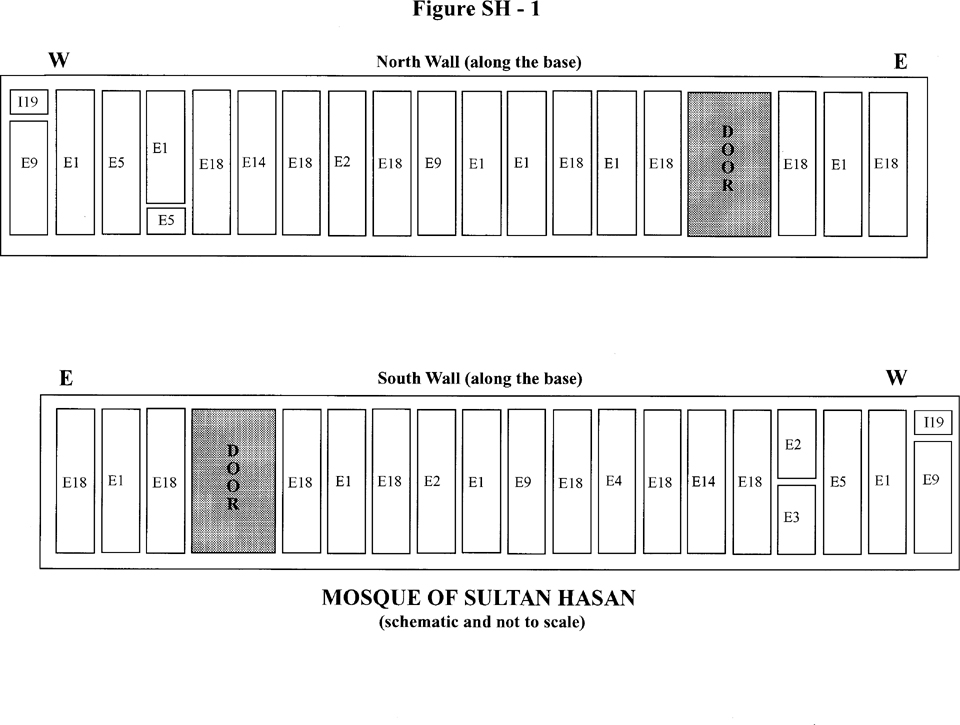
Qibli liwan north and south walls
(see Figure SH-1): these have panels along the base and are almost mirror
images of each other. Stone panels include MP imperial, black and greenish
black porphyries; WUS diorite; WB quartz diorite; WH conglomerate; WH
graywacke; pavonazzetto, sparry travertine; astracane dorato (d'Egitto?); and
light gray marble. Light gray marble and WH graywacke are used for trim.
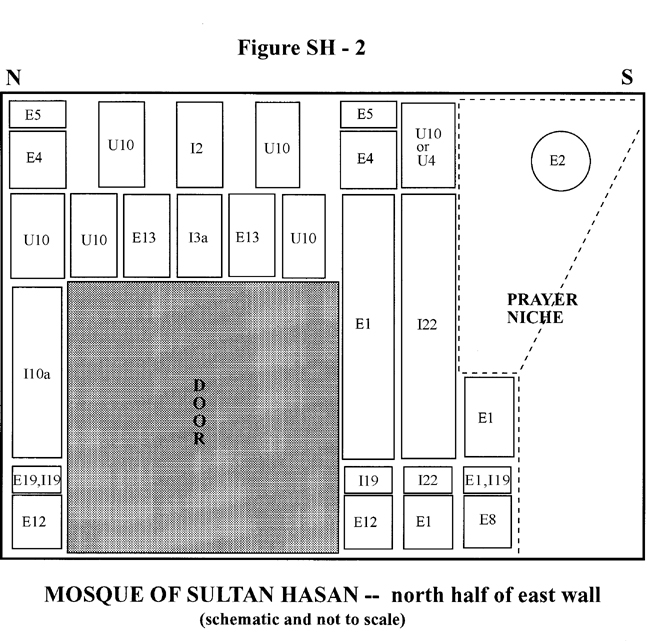
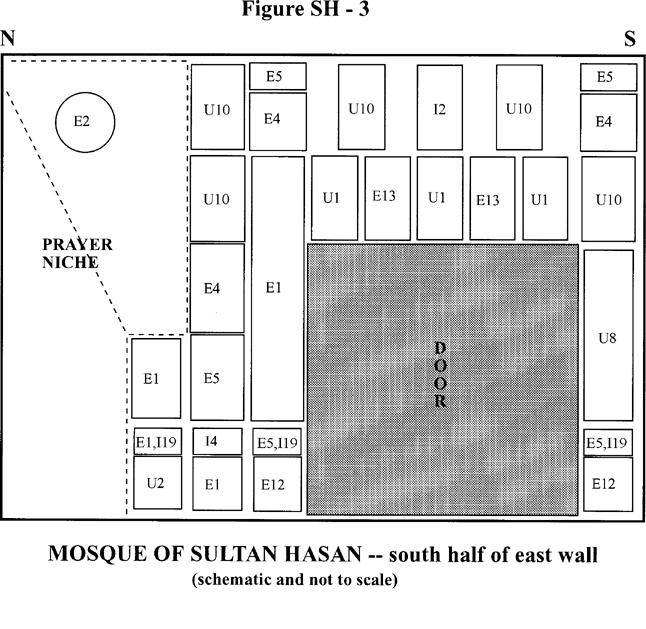
Qibli liwan east wall (see
Figures
SH-2 and SH-3): panels of MP red and greenish black porphyries, WB quartz
diorite, WUS diorite, Aswan granodiorite, WH graywacke, banded travertine,
verde antico, astracane dorato (d'Egitto?), broccatelli d'Egitto?, bianco e
nero antico, pavonazzetto, cipollino rosso brecciato, bigio antico, mottled
pink limestone/marble, and swirled yellow/pink limestone [U8].
Qibli liwan mihrab: there are three
tiers of panels — Aswan granodiorite, MP greenish black porphyry, cipollino
rosso brecciato, and mottled pink marble/limestone [or occhio di pavone rosso?]
(upper tier); verde antico, WUS diorite, and MP imperial porphyry (middle
tier); and MP imperial porphyry, WUE serpentinite, and swirled yellow/pink
limestone [U8] (lower tier). These panels are framed with "white"
marble and WH graywacke trim plus some astracane dorato (d'Egitto?). The jogged
design above the mihrab uses "black" and "white" marbles,
astracane dorato (d'Egitto?), and swirled yellow/pink limestone/marble. Four
flanking columns (two on each side) are Proconnesian marble with Islamic capitals.
The wall paneling behind the innermost column pair is greco scrito?
MAUSOLEUM
Note: wall descriptions include
window and door niches. The trim strips on walls include WH graywacke,
"white" (and some Proconnesian) marbles, and astracane dorato
(d'Egitto?). The paneling extends up to a height of 8 meters.
North wall panels: Greco scritto and
a variety of other light gray marbles, cipollino verde, MP imperial and
greenish black porphyries, astracane dorato (d'Egitto?), WH graywacke, MC
gneiss (2), WUS diorite, cipollino rosso venato? and breccia di Settebassi (or
pavonazzetto?). There are also 4 rotae of MP greenish black porphyry and 2 more
of MP imperial porphyry.
South wall panels: cipollino verde,
MP imperial and greenish black porphyries, astracane dorato (d'Egitto?), Aswan
granodiorite, WUS diorite, and bigio antico. There are also 4 rotae of WUS
diorite and 2 more of MP imperial porphyry.
West wall panels: cipollino verde,
MP imperial and greenish black porphyries, verde antico, Aswan granodiorite, MC
gneiss (2 inside the NW door niche and 1 high up on the wall at far right),
cipollino rosso venato, astracane dorato (d'Egitto?), rosso antico, and bianco
e nero antico. There are also 4 rotae of verde antico and 1 of MP imperial
porphyry.
East wall panels: cipollino verde,
MP imperial and greenish black porphyries, astracane dorato (d'Egitto?), verde
antico, and WB quartz diorite (1 inside NE window niche). There are also 4
rotae of WUS diorite, and smaller pieces of bianco e nero antico, fior di
pesco, red limestone, and cipollino rosso brecciato.
Mihrab panels: there are three tiers
of panels — bigio antico, bigio lumachellato, africano, MP imperial and
greenish black porphyries, and WUE serpentinite (lower tier); pavonazzetto, WUS
diorite, and MP imperial porphyry (middle tier); and MP imperial and greenish
black porphyries, verde antico, and bigio antico (upper tier). Trim strips
include "black" and "white" marbles (mainly marmo bianco di
Carrara and bardiglio di Carrara), astracane dorato (d'Egitto?), and cipollino
verde.
Mihrab columns: there are 2 columns
on each side. The outer pair is pavonazzetto with Islamic capitals, and the
inner pair is Proconnesian marble with Corinthian capitals.
Pavement: Mokattam limestone and miscellaneous
"white" marbles.
Cenotaph: Proconnesian marble
overall but with small panels along the base of WH graywacke, fior di pesco,
bigio lumachellato, cipollino verde, verde antico, cipollino rosso venato,
astracane dorato (d'Egitto?), and a variety of light and dark gray marbles.
Visited by: JAH in '96, '97 &
'99; MB & LL in '99.
References: B-A89, 122-128; MW92,
61-66; S-WS88, 320; W02, 60-65.
#298 Mausoleum of
Amir Tankizbugha (1359 AD) H-10
There
is no information on the stone, but it is said to be "plain" inside.
Not
visited.
References:
S-WS88, 379; W02, 116-117.
#269 Madrasa
of Beshir Agha al-Gamdar (1360 AD) F-8
The only decorative stones are two
hexagonal columns of light gray marble (with Byzantine ? capitals) just inside
the entrance, and a lintel of MP imperial porphyry over the entrance. Ablaq
above the entrance consists of light gray marble and a green stone (possibly WH
graywacke).
Visited by: JAH in '98.
References: S-WS88, 333.
#45 Madrasa
of Amir Mithqal (1361-3 AD) H-4
Restoration: in 1913-16 by the
Comité, and more extensively in 1973-76 by the German Archaeological Institute.
The only decorative stones are in
the courtyard pavement, and in and around the mihrab. That these stones date
from the restorations is obvious by their relatively fresh (unweathered)
appearance and, in the case of the mihrab, the extensive use of two stone
varieties either rarely (WH conglomerate) or never (Aswan granite) used in
Mamluk mosques for wall veneer (but still readily available from quarries
today).
COURTYARD
PAVEMENT
Geometric patterns are formed using
fossiliferous red limestone (superficially resembling MP imperial porphyry),
and "black" and "white" marbles.
MIHRAB
Inside are panels of WH conglomerate
and Aswan granite plus a geometric design using purplish pink limestone,
"black" and "white" marbles, and red terracotta (replacing
some pieces of limestone).
Outside and flanking the mihrab are
panels of WH conglomerate and Aswan granite, and octagonal columns of Proconnesian
marble with Islamic capitals.
Visited by: JAH in '97.
References: S-WS88, 238; W02,
175-176.
#153 Mosque of
Khushqadam al-Ahmadi (1366 or 1377 AD) F-8
There is no decorative stone inside except
for two octagonal light gray marble columns flanking the prayer niche and two
more of the same opposite in the west liwan.
Visited by: JAH & MB in '99.
References: S-WS88, 335; W02, 108-109.
#125 Madrasa/Mosque
of Umm al-Sultan Sha'ban (1368-9 AD) G-7
The
only decorative stone is on the east wall of the madrasa/mosque.
MIHRAB
There are three tiers of panels in a
richly and beautifully decorated mihrab. Lower tier (l. to r.): WUS
diorite, occhi di pavone rosso (hereafter "O di PR", this variety is
reddish and has large rudist shells), black limestone/marble (new?), O di PR,
WUS diorite (center), black limestone/marble, O di PR, WUS diorite. Middle
tier (l. to r.): O di PR, verde antico, O di PR, bianco e nero antico, MP
imperial porphyry (center), bianco e nero antico, O di PR, verde antico, O di
PR. Upper tier (l. to r.): MP greenish black porphyry, verde antico, O
di PR (?, painted red), MP greenish black porphyry, O di PR (?, painted red),
WUS diorite (center), O di PR ?, MP greenish black porphyry, O di PR ?, verde
antico, MP greenish black porphyry. The trim consists of light gray marble and
WH graywacke with some new (?) black limestone (substituting for the WH
graywacke).
The half dome at the top of the mihrab
has a zig-zag pattern of light gray marble, WH graywacke, occhio di pavone
rosso and cipollino rosso venato. The mihrab is flanked by two hexagonal
columns of light gray marble with incised floral reliefs. The wall panels
behind are WH graywacke.
EAST
WALL OF THE QIBLI LIWAN
The uppermost tier of panels in the
mihrab continues across the adjacent wall and into the two flanking window
niches. The panels are very dirty and so hard to see but one is of bianco e
nero antico, and all the rest appear to be of verde antico and cipollino rosso
venato (many of the latter are painted red). There might be other stone
varieties present. In the half domes above the window niches there are strips
of light gray marble, WH graywacke, occhio di pavone rosso and cipollino rosso
venato.
MAUSOLEUM
(north side)
Apart from the cenotaph of light gray
marble, the only decorative stone is in the mihrab. Now only the upper of three
(?) original tiers remains. Everything below is replaced with plaster. The
upper tier consists of three panels of verde antico and one of cipollino rosso
venato. A fifth panel is missing. The trim as well as the geometric design at
the top of the mihrab consists of light and dark gray marbles, and WH
graywacke. The two flanking columns are like those in the adjoining madrasa/mosque.
A second mausoleum exists on the south
side of the qibli liwan. It was kept closed and locked, and reportedly has no
decorative stone inside.
Visited by: JAH in '98 & '99; MB in
'99.
References: B-A89, 129-131; MW92, 67;
S-WS88, 309; W02, 80-81.
#185 Mosque
of Assanbugha (1370 AD) G-5
Completely
rebuilt inside with no decorative stone now present.
Visited
by: JAH in '98.
References:
S-WS88, 281; W02, 130.
#131 Madrasa
of Ilgay al-Yusufi (1373 AD) G-7
The only decorative stones inside
are 2 columns on each side of the prayer niche. The inner pair are Aswan
granodiorite with white marble Corinthian capitals, and the outer pair are
octagonal light gray marble with Islamic capitals. The entrance has an
unusually large sill of uninscribed Aswan granodiorite.
Visited by: JAH in '97.
References: MW92, 68; S-WS88, 327; W02, 83-84.
#18 Mosque of al-Bakri (1374 AD) H-3/J-3
At the entrance
is a sill of uninscribed Aswan granodiorite and a lintel of WUS diorite. The latter
is flanked by new? panels of red limestone and cipollino rosso venato. Inside
the mosque the only decorative stone is in and around the mihrab, and all of
this appears to be new. The lower portion of the mihrab has panels of light
gray marble and a geometric pattern with "white" marble, red and
black limestones, and blue faience. In the upper part of the mihrab, and just
outside and above it, there is a joggled design using "white" marble,
red and black limestones, yellow astracane dorato d'Egitto?, and blue faience.
Visited by: JAH in '00.
References: none.
#139 Mausoleum of Yunus al-Dawadar (1382
AD) H-7
This building, which is partly in
ruins, is closed and locked, and so not accesible.
Visited by: JAH in '00.
References: S-WS88, 303; W02, 71-72.
#250 Mosque
of Aytmish al-Bagasi (1383 AD) H-7
There is no decorative stone inside.
Visited by: JAH in '97.
References: S-WS88, 314; W02, 75.